Stop Memorizing Formulas — Start Seeing the Math
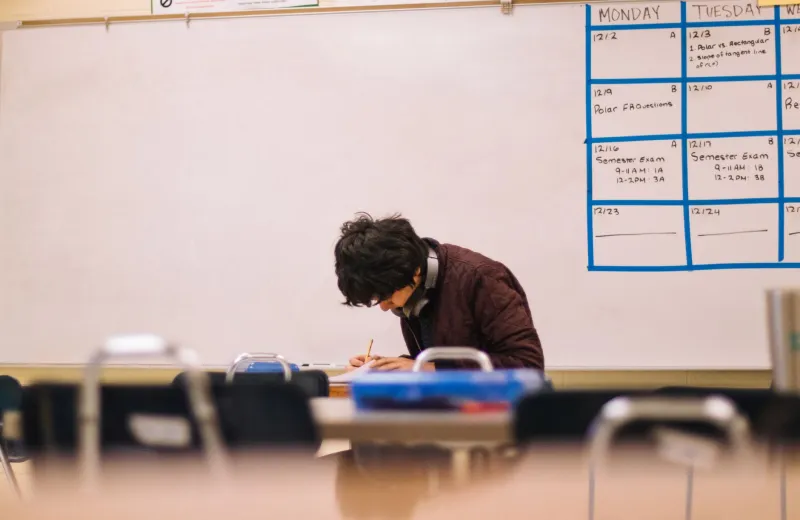
Every year, thousands of high school students sit down with a stack of index cards, scrawl derivatives and integral rules across them in a panic, and hope for the best on their AP Calculus exam. Some of them pass. A lot of them don't — and the ones who don't are often genuinely smart kids who just got sold the wrong strategy.
The dirty secret of calculus instruction? Memorization is one of the least effective ways to actually learn it.
The Problem With "Just Learn the Formula"
There's a reason your brain glazes over when you're staring at the quotient rule for the fifteenth time. Human memory isn't built for isolated, context-free information. Cognitive scientists call this the "inert knowledge problem" — when students can recite a formula but have zero ability to apply it when a problem shows up wearing different clothes.
Dr. John Sweller's research on cognitive load theory has been influencing math education for decades, and the takeaway is pretty clear: when working memory gets overloaded with disconnected facts, actual problem-solving collapses. Memorizing a dozen derivative rules without understanding why they work is a recipe for exactly that kind of overload.
AP Calculus exams — especially the free-response sections — are specifically designed to punish pure memorizers. The College Board isn't asking you to recite the chain rule. They're asking you to recognize when and why the chain rule applies, often buried inside a multi-step problem that looks nothing like your textbook examples.
What Pattern Recognition Actually Looks Like
So what's the alternative? It starts with training your brain to see mathematical structure instead of surface-level features.
Take the concept of related rates. A student who memorized a procedure will freeze when the problem involves a cone instead of a sphere. A student who recognizes the underlying pattern — that related rates problems are always about differentiating a relationship between variables with respect to time — can adapt on the fly. The structure is the same. Only the geometry changes.
This is what experienced math teachers mean when they talk about "mathematical maturity." It's not about knowing more formulas. It's about developing an instinct for how problems are built.
Here at CalcGenie, we see this play out constantly in tutoring sessions. Students who struggle aren't usually missing information — they're missing the mental framework to organize it. Once they start seeing calculus as a system of connected ideas rather than a bag of unrelated tricks, things click fast.
What the Research Says
Cognitive science research on expertise consistently shows that experts in any domain — chess, medicine, mathematics — don't just know more than beginners. They perceive differently. Expert chess players don't see individual pieces; they see patterns and configurations. Expert mathematicians don't see equations; they see structures and relationships.
A 2019 study published in the Journal of Educational Psychology found that students who received instruction emphasizing relational understanding — focusing on why mathematical procedures work — outperformed rote-instruction students not just on conceptual questions, but on procedural ones too. Understanding the pattern actually makes you faster at the mechanics, not slower.
This shouldn't be surprising. When you understand why the power rule works, you're not trying to remember a rule — you're reconstructing it from first principles in real time. That's far more reliable under exam pressure.
How Teachers Are Making the Shift
Some of the most effective AP Calculus teachers in the country have quietly restructured their courses around this philosophy. Instead of opening a unit with a formula, they open it with a question.
What happens to the slope of a curve as two points get infinitely close together? That question — explored through tables, graphs, and intuition — is the derivative. The formula comes later, almost as a natural conclusion rather than a starting point.
This approach takes longer upfront. Students sometimes get frustrated because they want the shortcut. But by the time the formula arrives, it feels inevitable rather than arbitrary, and it sticks.
Practice sets built around variation theory are another powerful tool — presenting the same core concept across wildly different surface contexts so students learn to see through the disguise. Instead of drilling twenty identical derivative problems, you give students five problems that all hinge on the same insight but look completely different on paper.
What You Can Do Right Now
If you're an AP Calculus student, here's a practical shift you can make today: every time you encounter a formula or procedure, ask yourself two questions. First, what kind of problem is this formula solving? Second, what would tip me off that this formula is the right tool?
Write those answers down. Not the formula itself — the context for the formula. Build a mental map, not a cheat sheet.
If you're a parent or tutor, look for signs that a student is pattern-blind. Ask them to explain a problem in plain English before they start solving it. If they can't, the formula memorization isn't helping — it's hiding the gap.
Calculus isn't a collection of rules. It's a way of thinking about change and accumulation. The students who get that — really get it — aren't just better at AP exams. They're better at every quantitative challenge they'll face in college and beyond.
The genie's already out of the bottle on this one. Pattern recognition isn't a shortcut. It's the actual skill.