Limits Aren't Hard — You Were Just Taught Them Wrong
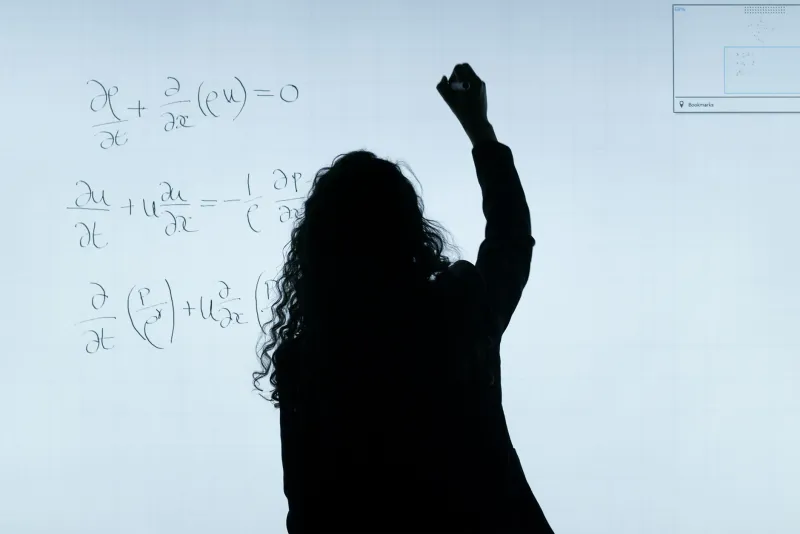
Let's be honest about something: the moment most calculus teachers write "for every ε > 0, there exists a δ > 0 such that..." on the board, about half the class mentally checks out. And honestly? That's not on the students.
The epsilon-delta definition of a limit is a logically airtight piece of mathematical machinery. It's also one of the worst possible ways to introduce the concept to someone who's never seen calculus before. The tragedy is that limits — the very foundation of everything calculus does — are actually one of the most natural, intuitive ideas in all of mathematics. They just get buried under notation before most students ever get a chance to feel what they mean.
Here at CalcGenie, we've worked with thousands of students who came to us convinced they were "just bad at math." Nine times out of ten, the real problem was a shaky understanding of limits. Fix that foundation, and the whole structure starts making sense.
What the Epsilon-Delta Definition Actually Gets Wrong (Pedagogically)
To be clear — the epsilon-delta definition isn't wrong. It's mathematically perfect. The problem is that it answers the question "how do we prove a limit rigorously?" before students have even figured out what a limit is in the first place.
Imagine trying to teach someone to drive by starting with the physics of internal combustion engines. Technically relevant. Practically disastrous.
When you lead with ε and δ, you're forcing students to wrestle with abstract machinery before they have any mental model to attach it to. Their brains are searching for a hook — some familiar concept to link this new idea to — and instead they get a wall of Greek letters.
Research in math education consistently shows that students learn abstract concepts more effectively when they're grounded in concrete, visual experiences first. The formal definition should be the destination, not the starting point.
A Better Mental Model: The Zoom-In Method
Here's how we think about limits at CalcGenie, and it changes everything for most students.
Imagine you're looking at a graph on your calculator. You see a function — maybe something like f(x) = (x² - 1)/(x - 1). There's a hole in the graph at x = 1 because the function is technically undefined there. But here's the question limits are actually asking:
If I zoom in closer and closer to x = 1, what value does the function seem to be heading toward?
That's it. That's a limit.
You're not asking what happens at the point. You're asking what value the function is approaching as you get infinitely close. Zoom in on that graph, and you'll see the function getting closer and closer to y = 2, even though it never actually lands there at x = 1. So we say the limit is 2.
No Greek letters required.
This "zoom-in" mental model maps directly onto what limits are doing mathematically, and it gives students something visual and tactile to hold onto. Try it with any graphing tool — Desmos is free and works great for this — and suddenly the idea becomes almost obvious.
The Approaching-From-Both-Sides Concept Nobody Explains Clearly
Once the basic zoom-in model clicks, there's a follow-up idea that trips students up: one-sided limits.
Here's the thing your teacher probably didn't emphasize enough. For a limit to exist at a point, the function has to be approaching the same value whether you're coming from the left side or the right side of that point. If the two sides disagree, the limit simply doesn't exist.
Think of it like two people walking toward each other on a bridge, both expecting to meet in the middle. If one of them ends up at a completely different spot than the other, there's no meeting point. The limit fails.
This is why step functions and certain piecewise functions cause so much confusion — the left and right sides don't agree, and students who only memorized a procedure don't understand why that matters.
How Calculus Anxiety Is Born (And How to Stop It)
Here's the uncomfortable truth: calculus anxiety is largely a manufactured problem. It gets created when students are handed abstractions without context, when they memorize steps without understanding purpose, and when they feel like the subject is a secret club with an incomprehensible entrance exam.
Limits are ground zero for this anxiety spiral. A student who doesn't genuinely understand limits will struggle with derivatives (which are defined using limits). They'll struggle with continuity, with integration, with convergence — because all of those concepts trace back to the same foundational idea.
But here's the flip side: when that foundation gets repaired, the entire subject starts to open up. Students who've spent a semester feeling lost often experience a genuine breakthrough moment when limits finally make intuitive sense. It's one of the most rewarding things to witness.
Practical Steps to Actually Get This
If you're a student reading this and limits feel fuzzy, here's a concrete game plan:
Start visual. Open Desmos and graph functions with interesting behavior near specific points. Zoom in. Watch what happens. Let your eyes do the work before your algebra does.
Talk through it out loud. Explain to yourself (or a friend, or a rubber duck on your desk) what you think the function is approaching. Using plain English before switching to notation is a research-backed technique for building conceptual understanding.
Work backwards from examples. Find a limit problem with a known answer and ask yourself why that's the answer. What's the function doing near that point? Can you see it on a graph?
Don't rush to the formal definition. The epsilon-delta definition will make much more sense once you have a dozen concrete examples living in your head. Let the intuition come first.
The Bottom Line
Limits are not the enemy. The way they're traditionally introduced often is. If you've been struggling with calculus and feeling like you're just not cut out for it, consider the possibility that you were handed a map with the legend missing.
The good news? It's never too late to go back and build the intuition you were supposed to get in the first place. That's exactly what CalcGenie is here for — not just to help you solve problems, but to help you actually understand what you're solving and why it matters.
Because once limits click? The rest of calculus starts to feel less like a gauntlet and more like a genuinely fascinating puzzle. And that's a feeling worth chasing.